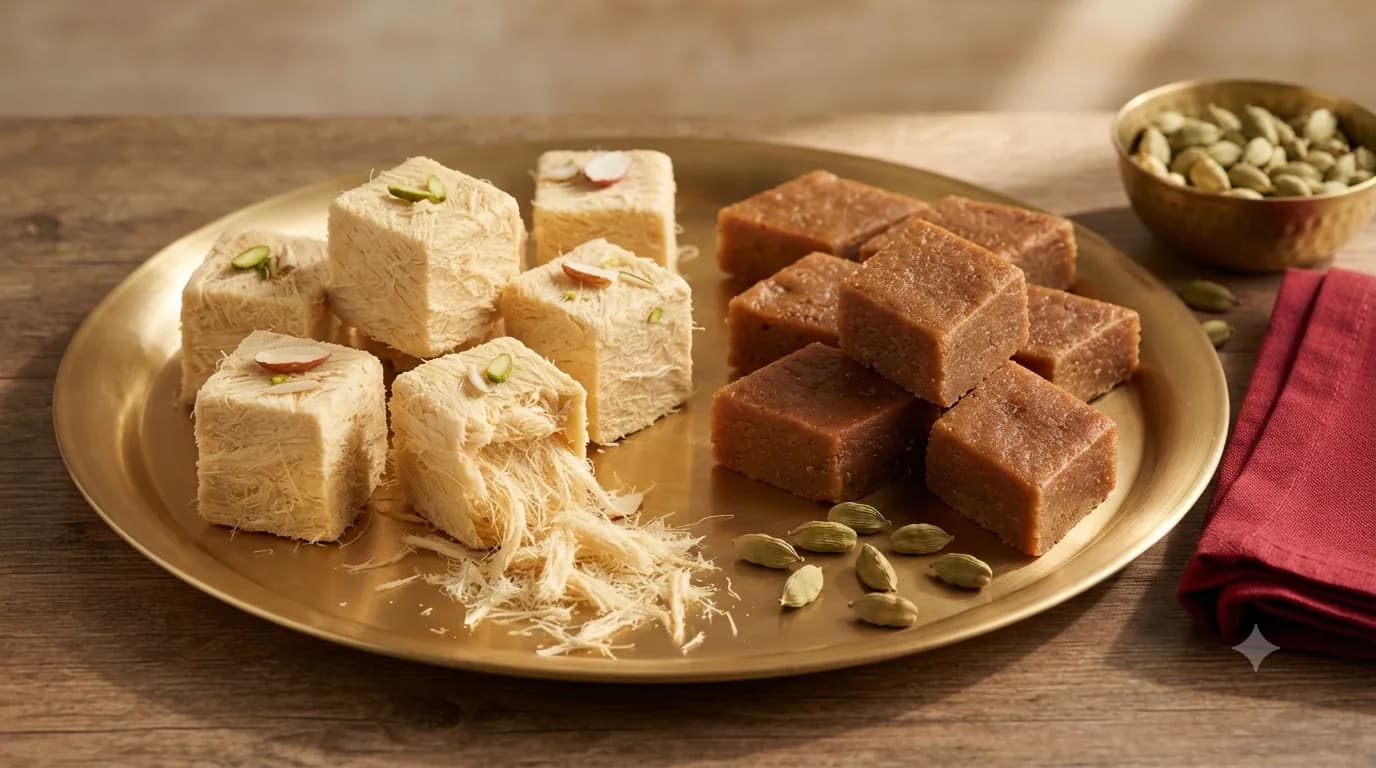
Agra Petha and Mathura Peda: Two Sweets Named After Cities
Agra's petha is made from a vegetable; Mathura's peda began, so the story goes, in Yashoda's kitchen. Where both come from, how they're made, and which to try.
By Laxman Bikaner · · 3 min read

Two cities a few hours down the highway from us, two sweets that carry their names everywhere they go. Agra petha and Mathura peda. They sound alike, they're both on our counter at 100 Ft Road, Ballabgarh, and they could not be more different.
Agra petha: the sweet made from a vegetable
Petha is made from ash gourd, the big white pumpkin called petha in Hindi. Not milk, not flour, a vegetable. That surprises a lot of people who've eaten it for years.
The gourd is peeled and cut into pieces, then soaked for a few hours in a solution of choona (slaked lime). That's the old trick that keeps the pieces firm and gives petha its crisp outside. Then the pieces are boiled until soft and soaked in sugar syrup. The result is translucent, crisp on the outside and juicy inside.
Agra is petha's home town, and the sweet shops there are famous for rainbows of it, flavoured with everything from kesar to paan to rose.
- Kesari Petha is coloured and flavoured with saffron, the most classic of the lot.
- Angoori Petha comes in small, grape-sized pieces (angoor means grape).
- Pan Petha tastes of paan, the mouth-freshener favourite.
- Sookha (dry) Petha is drained and dried, so it travels well and keeps longest.
Petha at our counter
- Kesari Petha₹300/ kg
- Angoori Petha₹300/ kg
- Pan Petha₹440/ kg
- Sookha Petha₹260/ kg
Mathura peda: the sweet of Krishna's town
Peda is made from khoya, milk cooked down to its solids, with sugar and elaichi, shaped into thick, soft rounds. The Mathura peda is the city's own style, brown in colour and full of cooked-milk flavour.
The story goes that in Mathura, Yashoda once let the milk boil over for too long, added sugar to save it, and fed it to little Krishna, who loved it. Whether you take that literally or not, peda has been offered to Krishna in Mathura ever since, and it's one of the most loved offerings at Janmashtami.
Peda travelled too. In the 1850s a halwai from Lucknow moved to Dharwad in Karnataka and took pedas with him, and the Dharwad peda is now famous in its own right.
Buying and keeping them
Good petha is crisp on the outside and juicy, not hard, in the middle. If the pieces have gone dry and chewy, they're old. Syrupy petha like angoori goes in a closed container with its syrup; dry petha just needs an airtight box.
Peda is a milk sweet, so treat it like one: closed box, cool place, and eat it within the best-before date on the tray.
Petha or peda?
| Agra Petha | Mathura Peda | |
|---|---|---|
| Made from | Ash gourd and sugar syrup | Khoya, sugar, elaichi |
| Texture | Crisp outside, juicy inside | Soft, dense, fudgy |
| Taste | Clean, sweet, flavoured | Rich, milky, a little caramel |
| Good for | Light sweet, travel (dry petha) | Prasad, Janmashtami, gifting |
Put simply: petha is the light, juicy one, and peda is the rich, milky one. A box with both covers everyone.
एक आगरा का, एक मथुरा का, दोनों दिल केBoth sit in our sweet shop menu alongside the rest of the counter, and for more on peda's main ingredient, read what khoya is.