How to Tell Fresh Mithai from Old: A Five-Second Counter Check
How to check if mithai is fresh before you buy: what to look at, what to smell, the best-before date every tray must show, and which sweets keep longest.
By Laxman Bikaner · · 3 min read

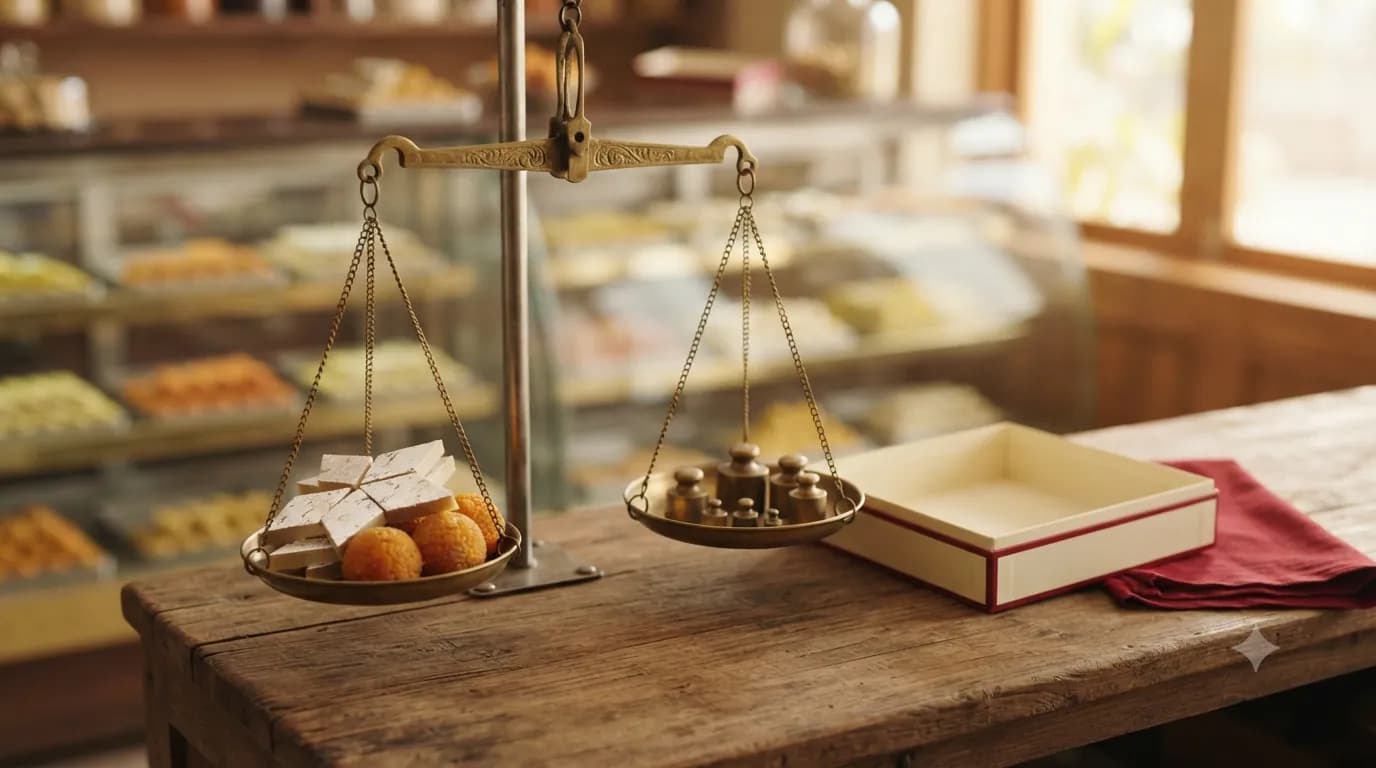
Diwali week, a crowded counter, thirty trays of mithai, and one question in your head: which of these was made today? Nobody wants to pay for a box and open it at home to find last week's barfi.
The good news is you don't need to be a halwai to check. Here's the five-second test we'd want every customer to use, at any counter in Ballabgarh or Faridabad, ours included.
Look first
- Edges. Fresh barfi and kalakand have soft, clean edges. Hard, dry, cracked edges mean it has been sitting out.
- The surface. A light natural sheen is good. A sweaty, wet look, or a dull, dried-out skin, is not.
- The bottom of the tray. Milk sweets that are turning start to leak a little liquid. A puddle under the kalakand is a no.
- Colour. Fresh mithai has an even colour. Patchy darkening, or anything that looks fuzzy, is an obvious no.
Then smell
Lean in a little. Khoya and chhena sweets should smell of milk, sweet and clean. If there's anything sharp or sour, even faintly, walk away. Your nose catches milk turning long before your eyes do.
For syrup sweets like rasgulla and gulab jamun, look at the syrup too. It should be clear. Cloudy or frothy syrup with a sour smell means it has started to ferment.
Check the best-before date on the tray
This one most people don't know: since 1 October 2020, every tray of loose mithai in India must show a best-before date. That's an FSSAI rule. The shop decides the date, depending on the sweet and the weather, but it has to be there, on or next to the tray.
So read it, and if you can't see one, ask. "Bhaiya, yeh kab tak theek hai?" is a perfectly normal question at a mithai counter, and a good shop will answer it straight.
Know which sweets keep longest
Not all mithai ages at the same speed. Roughly, from shortest life to longest:
| Type | Examples | What it means for you |
|---|---|---|
| Chhena and fresh milk sweets | Rasgulla, rasmalai, kalakand, chamcham | Buy close to the day, keep in the fridge |
| Khoya sweets | Milk cake, peda, khoya barfi | Buy for this week, not next |
| Besan and ghee sweets | Besan ladoo, motichoor, pinni | Keep a little longer, in a closed box |
| Dry-fruit and kaju sweets | Kaju katli, dry-fruit ladoo | The most forgiving, good for travel and gifting |
The tray's best-before date always wins over this table. It's just a way to plan: if you're buying on Monday for a puja on Saturday, choose from the bottom of the table, not the top.
Taste, if you're allowed
Many counters will let you taste a small piece, especially before a big order, so ask. Fresh khoya barfi is soft and slightly moist; old barfi is dry and crumbly in the middle. A fresh rasgulla springs back when you press it; an old one is rubbery. Kaju katli should be smooth, and we wrote a whole post on how to tell a good kaju katli.
Once it's home
- Milk and chhena sweets go in the fridge, in a closed box so they don't pick up smells.
- Dry sweets stay out, in an airtight dabba, away from the stove and the steam.
- Don't mix them. One rasgulla leaking syrup into a box of barfi ruins both.
- Buy smaller, more often, especially in summer. Thoda thoda lo, taaza taaza khao.
जो ताज़ा है, वही मीठा हैEverything on our counter is listed on the sweet shop menu, and if you're buying for a festival, here's what to take for Bhai Dooj.